Profile
Xsens is a world-leading Dutch company specializing in 3D motion tracking technology based on miniature inertial sensors. Founded in 2000 in Enschede, the Netherlands, by a team of researchers from the University of Twente, Xsens has become synonymous with high-accuracy Motion Capture (Mocap) and Inertial Measurement Units (IMUs). Since 2021, the company has operated as a brand under Movella Inc., while maintaining its strong identity and continued innovation in sensor fusion algorithms, calibration technology, and real-time motion analysis. Xsens technology is used across film, animation, biomechanics, sports science, healthcare, and — increasingly — robotics and autonomous systems.
The company’s core technological strength lies in its proprietary sensor fusion algorithms (XKF3 and XKF4) that combine data from accelerometers, gyroscopes, and magnetometers with GPS/GNSS and barometric data to deliver drift-free, accurate orientation, position, and velocity estimates. This technology is particularly valuable in robotics, where precise motion tracking is essential for control, navigation, and human-robot interaction.
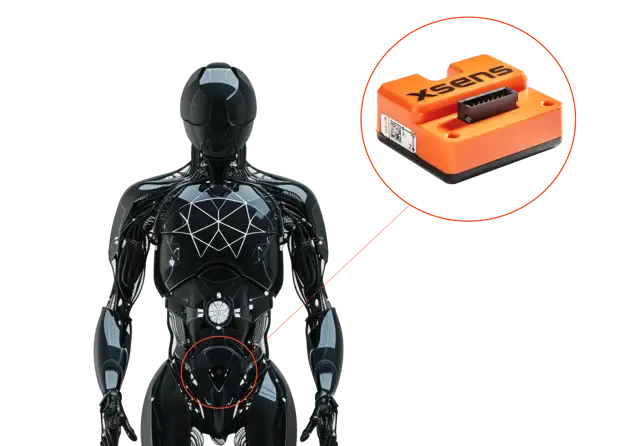
Xsens offers two primary robot-based product categories. The MTi series of industrial-grade inertial sensors (including the MTi-1, MTi-600, MTi-100, and MTi-300 lines) are widely used in robotics and autonomous vehicles. These compact modules provide high-frequency, low-latency data on 3D orientation (roll, pitch, yaw), acceleration, angular velocity, and magnetic field strength. They are integrated into legged robots, robotic arms, drones, unmanned ground vehicles (UGVs), and exoskeletons for stabilization, localization, feedback control, and sensor fusion with LiDAR or vision systems. Their robustness in vibration-heavy and magnetically disturbed environments makes them popular in industrial automation and field robotics.
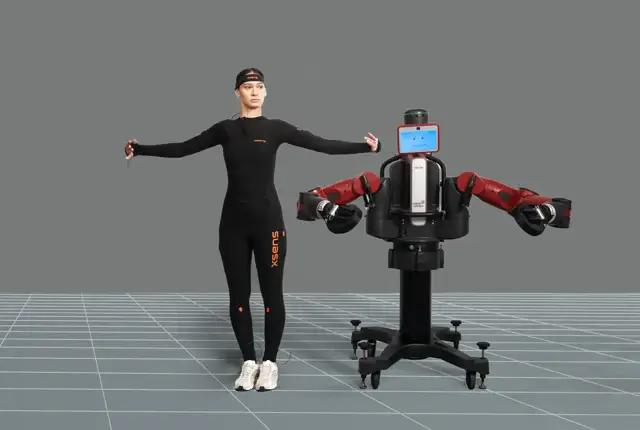
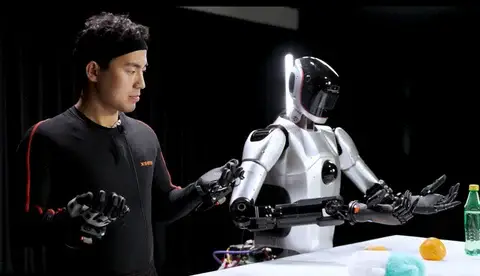
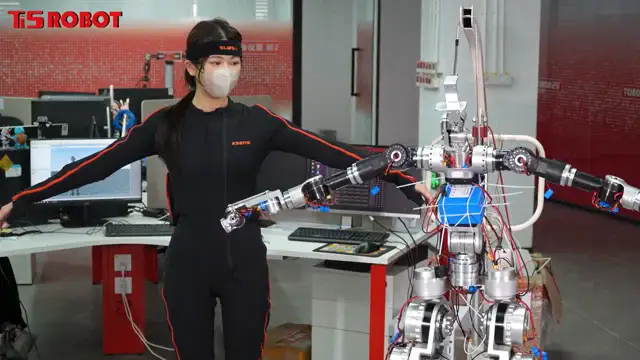
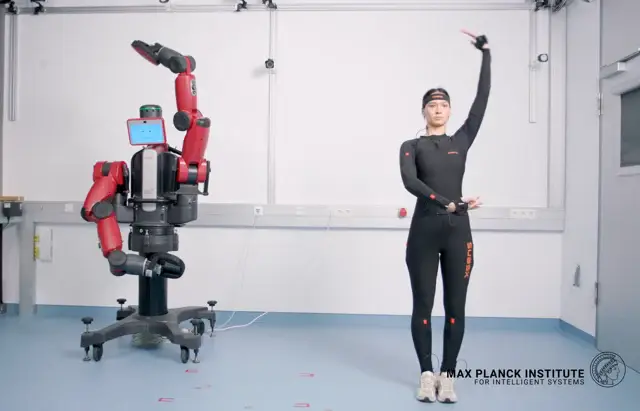
The second major line is the Xsens MVN motion capture system, available in wireless (Awinda) and suit-based (Link) versions. These systems deliver gold-standard full-body human motion capture with extremely high accuracy. In robotics development, they are extensively used to record high-quality human demonstration data for imitation learning, reinforcement learning, and training AI models for humanoid robots and advanced prosthetics. Major robotics labs and companies use Xsens MVN to analyze human movement patterns, develop natural robot locomotion, improve exoskeleton design, and study human-robot collaboration ergonomics. The newer Xsens DOT wearable sensor platform offers a more affordable, scalable option for real-time motion tracking in robotics research and training applications.
Xsens technology is valued in the robotics community for its reliability, ease of integration (with SDKs for ROS, MATLAB, Unity, and major programming languages), and minimal need for external infrastructure compared to optical motion capture systems. The sensors perform well in outdoor, GPS-denied, and magnetically challenging environments. As the field of humanoid robotics and embodied AI accelerates in 2026, Xsens continues to play a critical enabling role by providing the precise motion intelligence needed to bridge human movement and robotic control. The company maintains a strong focus on research collaboration with universities and robotics laboratories worldwide while expanding its industrial sensor business.

Map
Sorry, no records were found. Please adjust your search criteria and try again.
Sorry, unable to load the Maps API.