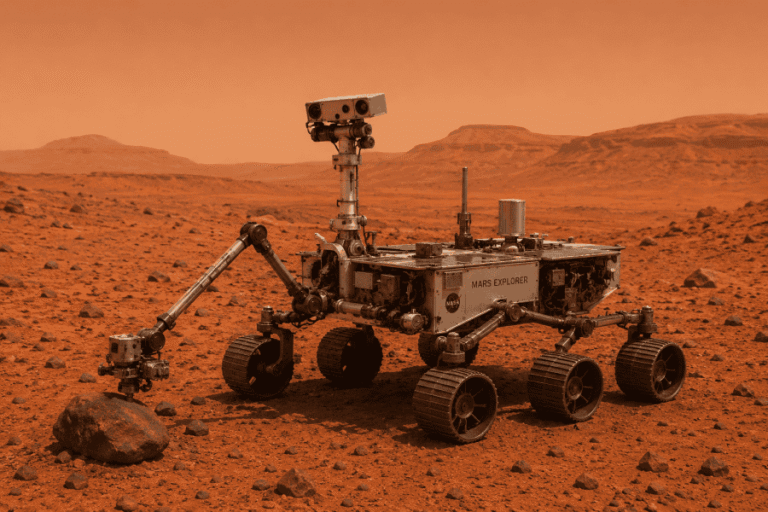
Unmanned robotic explorers have become the primary means by which humanity investigates the surfaces of the Moon and Mars. These machines operate in environments too hostile, distant, and expensive for constant human presence, performing scientific measurements, collecting samples, testing technologies, and paving the way for future crewed missions. As of 2026, robotic systems are no longer limited to simple wheeled rovers; they now include advanced autonomous platforms, legged robots, drones, and cargo haulers that perform increasingly complex tasks across both bodies.
The Moon and Mars present complementary but distinct exploration challenges. The Moon offers proximity (allowing near-real-time control), extreme temperature swings, and abundant sunlight in polar regions. Mars features a thicker atmosphere useful for aerobraking, greater distance (creating communication delays of up to 20 minutes one way), dust storms, and deeper scientific questions about past habitability. Robots address both locations through mobility, instrumentation, and growing autonomy.
On the Moon, robotic exploration began with the Soviet Lunokhod rovers in the 1970s and has accelerated with China’s Chang’e missions and NASA’s Commercial Lunar Payload Services (CLPS) program. Current and near-term missions focus on resource prospecting and terrain characterization. NASA’s 2026 Moon Base series includes Astrobotic’s Griffin lander delivering the FLIP rover and Blue Origin’s Mark 1 Endurance lander. These platforms test mobility systems ahead of crewed Artemis landings. Two companies, Astrolab and Lunar Outpost, are developing Lunar Terrain Vehicles (LTVs) capable of 10 km/h speeds and 200 km range, with autonomous navigation features. These solar-powered rovers will scout landing sites, move scientific instruments, and pre-position supplies before astronauts arrive.
Future lunar robots will also include flying drones. The MoonFall mission, slated for 2028, will deploy four short-hop drones to survey potential Artemis landing zones at the lunar South Pole. These aerial systems can reach areas inaccessible to wheeled vehicles, such as crater walls and permanently shadowed regions suspected of containing water ice.
Mars exploration relies on increasingly sophisticated rovers. NASA’s Perseverance has collected dozens of rock and soil samples since 2021, while its predecessor Ingenuity demonstrated the value of aerial scouting. Japan, China, and Europe are also developing Mars surface assets. The most ambitious near-term robotic effort remains Mars Sample Return (MSR), a joint NASA-ESA campaign. Although the original architecture has evolved, recent studies explore single-launch concepts using hybrid propulsion and autonomous quadruped robots to retrieve cached samples. Legged platforms such as adaptations of Boston Dynamics’ Spot or ETH Zurich’s ANYmal are being evaluated for their superior mobility over rocky or sandy terrain compared with traditional wheels.
The core roles of surface robots fall into several categories:
Scientific investigation remains the primary mission. Rovers carry instruments to analyze mineralogy, search for organic compounds, and measure radiation and seismic activity. On Mars, they drill into rocks and extract cores; on the Moon, they will soon prospect for volatiles in polar craters.
Sample collection and return represents a major leap. Perseverance has already cached samples for MSR missions. Future lunar robots will similarly gather regolith for return to Earth or in-situ analysis.
Technology demonstration and infrastructure building is growing rapidly. Robots test oxygen production from regolith, 3D-print landing pads, and construct roads or habitats using local materials. These in-situ resource utilization (ISRU) tasks reduce the mass that must be launched from Earth.
Reconnaissance and scouting support both science and eventual human missions. Aerial drones and high-speed rovers such as NASA’s ERNEST prototype map terrain, identify hazards, and locate resources at speeds several times faster than current Mars rovers.
Advancements in autonomy are transforming what robots can accomplish. Communication delays make real-time control impractical on Mars and increasingly limiting on the far side of the Moon. Modern rovers use onboard AI for path planning, hazard avoidance, and decision-making. NASA’s ERNEST tests have shown a prototype traversing 26 kilometers in desert terrain with minimal human intervention, achieving speeds up to 1 km/h—twenty times faster than Perseverance’s typical driving rate. Future systems will combine active suspension, visual odometry, and machine learning to operate safely for months or years with only occasional ground commands.
Swarm and multi-robot architectures are another emerging trend. Coordinated teams of small robots can cover more ground, provide redundancy, and perform parallel tasks such as simultaneous mapping and sampling. On Mars, a mother rover could deploy smaller scouts; on the Moon, multiple LTV-class vehicles could maintain continuous operations across a base site.
These capabilities directly support the transition to human exploration. Robotic precursors will characterize radiation environments, locate and extract water ice, and test life-support technologies. They will also perform dangerous tasks such as initial construction and maintenance in areas where humans cannot yet operate comfortably.
Challenges remain significant. Lunar dust is abrasive and electrostatically charged, while Martian dust can coat solar panels and clog mechanisms. Both environments experience extreme temperature cycles that stress electronics and mechanisms. Power systems must cope with long lunar nights and Martian dust storms. Radiation and micrometeoroids threaten long-term reliability. Engineers mitigate these through robust design, redundancy, and increasingly sophisticated fault detection.
Cost and launch constraints also shape robotic missions. Smaller, more frequent CLPS-style deliveries on the Moon allow rapid iteration, while Mars missions remain larger and less frequent. Advances in commercial landers and reusable rockets are lowering barriers and enabling more ambitious robotic campaigns.
By 2035, robotic systems are expected to perform the majority of surface work on both the Moon and Mars. They will maintain habitats, conduct routine science, and operate resource-processing plants while humans focus on high-value exploration and discovery. The robots of tomorrow will not merely observe these worlds—they will actively reshape them to support sustained human presence.

Author: RobotsInc.com
The RobotsInc Editorial Team is dedicated to covering the global robotics industry with accuracy, clarity, and technical insight. Our editors research emerging technologies, industry trends, product launches, and business developments to deliver informative, fact-based articles for engineers, manufacturers, researchers, investors, and robotics enthusiasts.