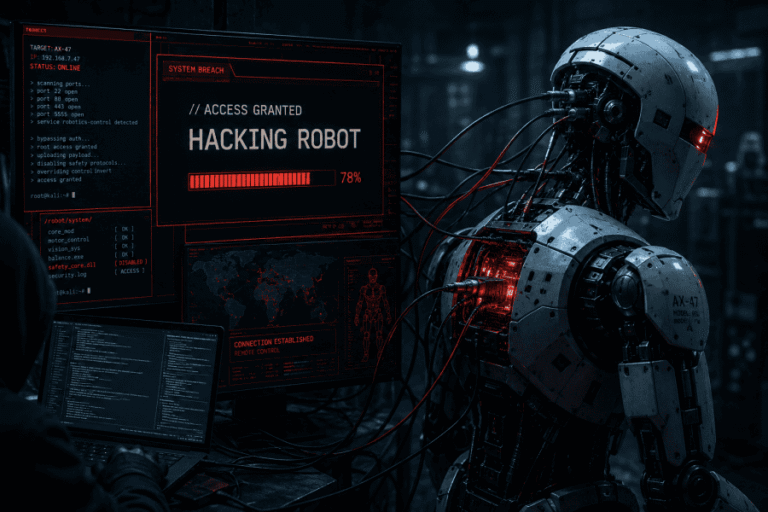
Robots now operate in factories, homes, battlefields, shopping malls, and city streets. Their increasing autonomy and connectivity have created a broad attack surface that includes industrial systems, consumer devices, military platforms, security patrols, and delivery fleets. While these machines deliver efficiency and capability, they also introduce new risks where cyber, physical, and AI-based threats can cause significant harm.
Industrial robots form the backbone of modern manufacturing. These systems run on proprietary controllers connected to enterprise networks for remote monitoring and updates. A common vulnerability lies in outdated firmware and weak authentication. Many robotic arms and collaborative robots (cobots) still use default passwords or unencrypted protocols such as Modbus and Profinet. In 2021, researchers at the Georgia Institute of Technology demonstrated how an attacker could alter a robot’s motion commands over the network, causing it to drop parts or collide with equipment without triggering safety stops. Supply-chain attacks targeting robot operating systems or third-party vision software add another layer of risk. Because many factories prioritize uptime over frequent patching, exploits can persist for years.
Consumer robots present different but equally serious issues. Devices like robotic vacuums, lawn mowers, and home assistants collect continuous sensor data while connecting to household Wi-Fi. Weak default credentials and unencrypted communication between the robot and its cloud backend allow unauthorized access. A compromised robot vacuum can map a home’s layout and send that data to an attacker. Toys with cameras and microphones have repeatedly been shown to stream video or audio to unauthorized parties. Voice-command interfaces remain vulnerable to adversarial audio attacks that inject hidden commands without the owner noticing. Because these devices are inexpensive and updated infrequently, they often run obsolete software long after vulnerabilities are disclosed.
Military robotics faces the highest stakes. Unmanned aerial vehicles, ground robots, and autonomous ships rely on GPS, satellite links, and tactical data links. GPS spoofing has already been used against commercial drones and remains a documented threat to military systems. In contested environments, jamming or spoofing can redirect a platform or cause it to crash. Software supply-chain risks are equally concerning; malware inserted during development could allow an adversary to seize control after deployment. Physical capture is also realistic. A downed drone or disabled ground robot can be reverse-engineered to extract encryption keys or mission data. Unlike consumer devices, military platforms rarely receive over-the-air patches in the field, extending the window of exposure.
Security robots used for perimeter patrol and crowd monitoring combine sensors, autonomous navigation, and sometimes weapons or tasers. These platforms are often deployed on corporate or municipal networks with limited segmentation. An attacker who gains access to the control dashboard can issue false alerts, disable cameras, or steer the robot into sensitive areas. Facial recognition and object-detection models running on these robots are susceptible to adversarial examples—subtle changes to clothing or signage that cause the system to misidentify threats. Physical tampering is straightforward because the robots are designed to operate in accessible public spaces. Weaknesses in over-the-air update mechanisms have been shown to allow persistent backdoors in several commercial security-robot platforms.
Delivery robots and autonomous vehicles introduce supply-chain and public-safety dimensions. Sidewalk delivery robots and drone fleets carry valuable cargo and operate in open environments. Many rely on cellular or Wi-Fi connections that can be intercepted or jammed. An attacker who compromises the fleet-management software can reroute robots, open cargo compartments, or disable them in high-traffic areas. In 2023, researchers demonstrated how spoofed traffic signals could mislead autonomous delivery vehicles into unsafe maneuvers. Physical attacks are simple: a person can lift a small delivery robot or cover its sensors. Because these robots often share public infrastructure with pedestrians, any successful compromise creates direct risks to bystanders.
Several challenges cut across all categories. First, the robotics industry lacks standardized secure-by-design practices. Many platforms still treat cybersecurity as an afterthought rather than a core requirement. Second, the convergence of operational technology and information technology means that compromising a robot can provide a foothold into broader industrial control systems or enterprise networks. Third, artificial intelligence components introduce novel attack vectors. Training-data poisoning, model inversion, and membership inference attacks can degrade performance or leak sensitive information. Finally, the human element remains a persistent weakness. Operators often reuse passwords, delay updates, or grant excessive privileges during integration with legacy systems.
Mitigation requires a layered approach. Manufacturers must adopt secure boot, code signing, and regular cryptographic updates. Network segmentation, zero-trust architectures, and runtime integrity monitoring can limit lateral movement after an initial compromise. For military and security platforms, resilient navigation that combines GPS with inertial and visual odometry reduces reliance on any single signal. Consumer devices need privacy-preserving defaults and automatic security updates that do not require user intervention. Regulators and standards bodies are beginning to address these gaps with frameworks such as NIST’s robotics cybersecurity guidelines and proposed EU requirements for cyber-resilient machinery, yet adoption remains uneven.
Robots will continue to proliferate because the economic and operational benefits are clear. However, every increase in autonomy and connectivity expands the potential damage an attacker can inflict. Addressing these vulnerabilities demands coordinated action from manufacturers, integrators, operators, and policymakers. Without deliberate investment in security, the robots we rely on for production, convenience, defense, and logistics could themselves become the weakest link in our critical infrastructure.

Author: RobotsInc.com
The RobotsInc Editorial Team is dedicated to covering the global robotics industry with accuracy, clarity, and technical insight. Our editors research emerging technologies, industry trends, product launches, and business developments to deliver informative, fact-based articles for engineers, manufacturers, researchers, investors, and robotics enthusiasts.