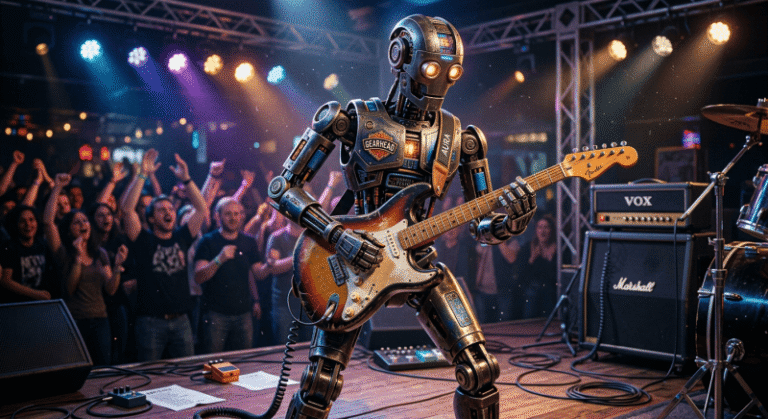
Imagine stepping into a dimly lit venue in 2032. A sleek humanoid robot stands center stage holding a Fender Stratocaster. The crowd falls silent as it launches into Jimi Hendrix’s “Little Wing,” delivering the exact expressive bends, feedback, and microtiming that defined the legend. Without missing a beat, it shifts into a flawless Taylor Swift ballad, then improvises an original piece that sounds like what Eddie Van Halen might have written had he lived into the 2020s. The performance is transcendent. The unsettling part? Most audience members have no reliable way to tell whether this is a human-level emulation driven by generative AI, a pre-programmed routine, a deepfake projection, or something entirely new. This scenario is rapidly approaching, and it sits at the intersection of two converging revolutions: the collapse of our ability to distinguish AI-generated content from human creation, and the embodiment of that technology in advanced robotics.
As of 2026, telling synthetic content from real content has become an escalating technological arms race that generative AI is winning. Early detectors for text relied on statistical “tells” such as burstiness (variation in sentence length) or perplexity. These worked against GPT-3.5 but largely fail against today’s frontier models. Modern large language models are explicitly trained through reinforcement learning to sound more human, simulating natural inconsistencies, personal quirks, and even deliberate minor errors. As a result, many commercial AI detectors hover around 50-70% accuracy, with high false-positive rates that make them unreliable for serious use.
The challenge is even greater with visual and audio content. Image generators have moved far beyond the obvious deformities of early Midjourney or DALL-E. Newer systems produce physics-aware lighting, realistic skin textures, and consistent character details that fool both automated detectors and human experts. Video synthesis tools can now generate minutes-long clips with coherent motion, emotional nuance, and lip synchronization. Audio may be the most difficult domain: voice-cloning systems need only seconds of sample audio to create convincing speech, while music generation models like successors to Suno and Udio can produce full songs complete with realistic instrumentation, natural breathing artifacts, and emotional phrasing. Forensic tools that analyze spectrograms or pixel-level artifacts are constantly outpaced as generators incorporate adversarial training specifically designed to evade detection.
Watermarking efforts—such as invisible statistical signatures or metadata standards like C2PA—offer partial solutions, but these can be stripped, spoofed, or simply ignored when content is re-recorded or re-rendered. The philosophical problem compounds the technical one: much “real” human content is heavily edited, enhanced with AI tools, or produced collaboratively. The line between “AI-assisted” and “AI-generated” grows increasingly blurry. Studies consistently show that even trained professionals (journalists, musicians, forensic analysts) are frequently fooled once output quality crosses a certain threshold. At scale, in real time, or across high volumes of content, human judgment becomes overwhelmed. We are approaching a world where provenance—trusted chains of custody proving origin—may be the only reliable defense, yet implementing that universally remains elusive.
This authenticity crisis moves from troubling to transformative when the same generative capabilities are embodied in physical robots. Robotics has historically been limited by rigid, pre-programmed behaviors that lacked fluidity and emotional expression. Those barriers are collapsing. Advanced multimodal AI models that link language, music, vision, and motor control are being integrated into humanoid platforms from companies like Tesla (Optimus), Figure, and Agility Robotics. The result is machines capable of generating and executing novel physical behaviors in real time.
Nowhere is this more viscerally illustrated than in the thought experiment of the robot guitar player. Technical feasibility is already within sight. Dexterous robotic hands with 20+ degrees of freedom, tactile sensors, and force feedback can replicate the complex fingerings, string bending, and body interaction required for expressive guitar playing. Pair this hardware with generative music models trained on virtually every recorded guitar performance in history, plus motion-capture data from legendary players. The robot gains the ability to do far more than copy.
It could channel Hendrix’s raw psychedelic energy one moment, then pivot to the intricate classical-influenced fingerstyle of Tommy Emmanuel or the percussive slap techniques of modern players. It could improvise live in response to audience energy, blend disparate genres seamlessly, or generate entirely new material in the statistical “style” of any artist—living, dead, or even fictional—while adjusting dynamics, timing, and timbre with superhuman precision yet still incorporating learned “human” imperfections when desired. Because the underlying models can create music that passes blind tests as human composition, and the robot can execute it with both technical perfection and simulated emotional depth, the performance becomes almost impossible to categorize as purely “AI” or “real.”
The implications for robotics and society are profound. Economically, the live music industry faces disruption on a scale comparable to the arrival of recorded music itself. Why hire a human session guitarist or pay premium ticket prices for fallible human performers when a robot can deliver flawless, customized experiences that never tire, never miss cues, and can “be” any artist the audience desires? Human musicians may shift toward curation, emotional direction, novel composition, or marketing their own unique humanity as a premium feature—“100% human, no AI”—much like the organic food movement. Hybrid performances, where humans and robots collaborate in real time, could spawn entirely new art forms.
Legally and ethically, the problems multiply. Ongoing lawsuits over training data for AI music models hint at the coming storm. Can an artist’s estate prevent a robot from performing in their likeness? Does generating new music “in the style of” a specific guitarist constitute copyright infringement? When the performance is physical—vibrating strings, real amplifiers, visible effort—questions of authenticity, moral rights, and disclosure become even thornier. Regulatory efforts, such as mandatory labeling for AI-involved performances, are likely but will be difficult to enforce consistently.
Beyond music, this technology accelerates broader robotic adoption. Companion robots, educators, and performers gain credibility when their outputs—speech, movement, musical interludes—are indistinguishable from human ones. In space exploration or hazardous environments, robots could provide convincing entertainment, therapy, or cultural preservation using the same generative engines. Yet trust erosion is inevitable. The uncanny valley is shifting from appearance to behavior and “soul.” If we cannot reliably tell whether a robot’s empathy, creativity, or artistry is generated or genuine, how do we form authentic relationships with these machines?
Philosophically, this recalls Walter Benjamin’s concept of the “aura” of an original work of art—its unique presence in time and space that mechanical reproduction cannot replicate. A robot guitarist may reproduce every nuance of a Hendrix solo, yet something ineffable—the lived struggle, vulnerability, and risk of a human performer—may still feel absent. Or perhaps we will adapt, learning to value emotional impact and shared experience over origin. Imperfection itself may become a luxury good, a deliberate signal of humanity.
The convergence of indistinguishable AI content and advanced robotics does not spell the end of creativity. It may instead force a redefinition. Humans could be liberated from technical execution to focus on higher-level direction, emotional authenticity, and novel ideas. Robots could democratize virtuosity, teach skills, preserve dying art forms, and create personalized experiences at scale. But realizing these benefits requires proactive adaptation: robust provenance systems, cultural norms around transparent disclosure, new legal frameworks, and a societal commitment to valuing human connection even when machines can simulate it convincingly.
The line between real and artificial has not merely blurred—it is vanishing in domains once thought uniquely human. The robot guitarist who can play anything by anyone at any time is not science fiction. It is a coming cultural mirror. How we respond to it—whether with fear, regulation, embrace, or creative collaboration—will say as much about us as it does about the machines.

Author: RobotsInc.com
The RobotsInc Editorial Team is dedicated to covering the global robotics industry with accuracy, clarity, and technical insight. Our editors research emerging technologies, industry trends, product launches, and business developments to deliver informative, fact-based articles for engineers, manufacturers, researchers, investors, and robotics enthusiasts.