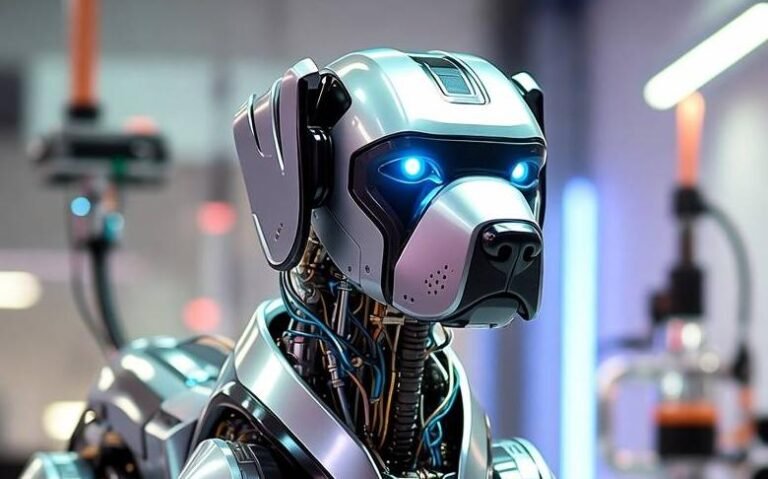
In 2026, robotic dogs and quadruped robots have transcended their sci-fi origins to become indispensable tools in military, industrial, and everyday applications. These agile, four-legged machines, inspired by animal locomotion, navigate complex terrains that challenge wheeled or tracked alternatives. From Boston Dynamics’ Spot patrolling oil rigs to affordable Unitree models aiding research, the field is booming. This blog post delves into their evolution, technology, key players, applications, and future prospects, painting a vivid picture of a world where robots mimic nature’s most adaptable creatures.
A Brief History: From Lab Experiments to Real-World Deployments
The journey of quadruped robots began in the mid-2000s with Boston Dynamics’ BigDog, a hydraulic beast developed for the U.S. military to carry heavy loads over rough terrain. By the 2010s, electric models like Spot (commercialized in 2019) reduced noise and weight, enabling broader adoption. Fast-forward to 2026, and the market has exploded. According to DroidAge, the global quadruped robot market is valued at $286 million, projected to reach $759 million by 2034, driven by a 19.4% CAGR. Chinese manufacturers like Unitree have democratized access, shipping thousands of units at prices as low as $1,600, while Western firms focus on high-end, ruggedized versions.
Ukraine’s conflict has been a real-world testing ground, deploying over 15,000 unmanned ground vehicles (UGVs) by 2025 for logistics and combat. As RobotToday’s analysis notes, these robots extend the “kill zone” and reshape warfare economics. Meanwhile, consumer models like Unitree’s Go2, with AI integration, have made robotic dogs accessible for education and hobbies, marking a shift from niche research to mass deployment.
The Technology Behind the Paws: Gaits, Hardware, and AI
At their core, quadruped robots excel due to advanced biomechanics. They use dynamic gaits—coordinated leg movements—to traverse obstacles. A walk gait ensures static stability for precise tasks, while a trot or gallop achieves speeds up to 6 m/s on uneven ground. ElectronsX highlights that these robots employ real-time gait adjustments via sensors like LiDAR and IMUs, allowing them to climb stairs or navigate mud with ease.
Hardware stacks are evolving rapidly. Most platforms feature lithium-ion batteries (0.5-2 kWh for 60-120 minutes of runtime), brushless servo motors with harmonic drives for efficient torque, and perception systems for 360-degree awareness. AI integration, powered by vision-language models, enables natural language commands, such as “patrol the perimeter.” By 2026, models like Spot boast manipulator arms for tasks like valve-turning, transforming them from mere scouts to interactive workers.
Challenges persist, including battery life and weatherproofing. However, advancements in GaN motor controllers and rare-earth magnets have addressed supply chain bottlenecks, making robots more robust for outdoor use.
Key Players and Platforms: A Diverse Ecosystem
The quadruped market in 2026 is dominated by a mix of innovators. Boston Dynamics’ Spot remains the gold standard, with over 1,500 units deployed for industrial inspection and public safety. Priced at around $75,000, it offers unparalleled stability and a vast payload ecosystem, including thermal cameras for hazard detection.
Unitree Robotics leads the affordable segment, capturing 60% of the market with models like the Go2 (1,600) and B2 (15,000+). These Chinese-made robots prioritize cost-performance, featuring quasi-direct drive actuators for agile movement. Deep Robotics’ X30 focuses on industrial applications, excelling in energy sector inspections with IP66 weather resistance.
In the military realm, Ghost Robotics’ Vision 60 is a standout, deployed for reconnaissance and even armed operations. CMRA’s review of nearly 40 Chinese companies underscores the “two-power” landscape, with Unitree and Deep Robotics driving innovation, while Western firms like ANYbotics offer ATEX-certified models for hazardous environments.
This competition has spurred a “multi-layered” ecosystem, as per CMRA, with specialized players targeting niches like emotional companionship (e.g., MagicLab) or research platforms (e.g., AgiBOT).
Applications: From Battlefields to Boardrooms
Quadruped robots are transforming industries with their versatility. In defense, Ukraine’s use of UGVs for supply runs exemplifies their role in reducing human risk, with robots holding positions for days in hostile zones. The U.S. military employs Ghost Robotics’ platforms for base security, leveraging AI for autonomous patrols in GPS-denied areas.
Industrially, oil and gas firms like BP deploy Spot for methane leak detection, cutting inspection costs by up to 50%. Construction companies use these robots for site mapping, generating 3D models to monitor progress and enhance safety. In research, affordable models like Unitree’s Go1 facilitate AI training, with universities experimenting on everything from gait optimization to human-robot interaction.
Consumer applications are emerging too, with robotic dogs serving as educational tools or even pets. For instance, Unitree’s Go2, with its GPT-powered interface, teaches coding while providing entertainment. ROI is compelling: A single Spot can save $200,000 annually in manual labor for multi-floor facilities, per Boston Dynamics’ data.
However, limitations exist. Quadrupeds struggle with extended missions due to battery constraints and are costlier than wheeled alternatives for flat terrains. Ethical concerns, especially in military uses, have sparked debates on autonomous weapons.
Challenges and Future Trends: The Road Ahead
As of 2026, the biggest hurdles include supply chain dependencies on rare-earth magnets and geopolitical tensions, which could delay production. Battery technology lags, with most robots limited to two hours of operation, though swappable designs are mitigating this.
Looking forward, the integration of embodied AI promises multi-day autonomy and advanced manipulation. By 2030, we may see quadrupeds collaborating in swarms for disaster response, as hinted in DARPA’s programs. The market is shifting toward hybridization, with wheeled-legged models for mixed terrains. Regulations, like those addressing AI ethics, will shape growth, ensuring safe deployment.
In summary, robotic dogs and quadruped robots in 2026 represent a leap in mobility and intelligence, blending biology with technology. From redefining warfare to enhancing daily operations, they’re proving that four legs are better than wheels in an unpredictable world. As costs drop and capabilities expand, expect these mechanical canines to become even more ubiquitous, ushering in a new era of automation.

Author: RobotsInc.com
The RobotsInc Editorial Team is dedicated to covering the global robotics industry with accuracy, clarity, and technical insight. Our editors research emerging technologies, industry trends, product launches, and business developments to deliver informative, fact-based articles for engineers, manufacturers, researchers, investors, and robotics enthusiasts.