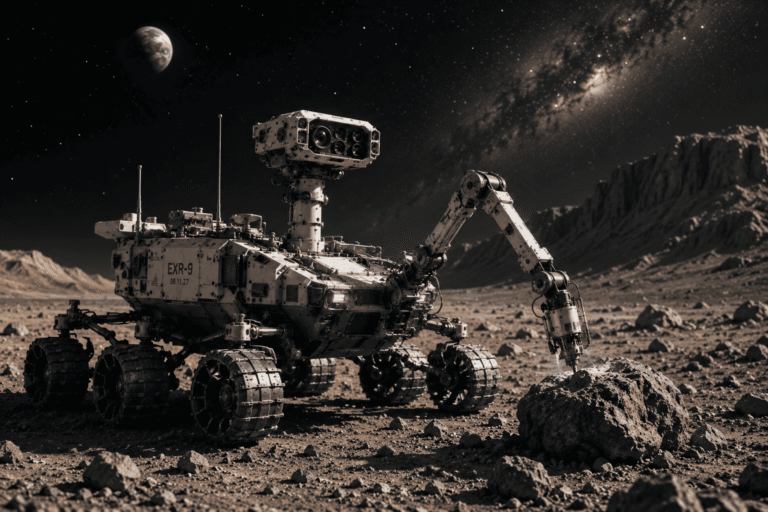
Space exploration has always captured humanity’s imagination, but the vast distances, extreme environments, and inherent dangers of space make it one of the most challenging frontiers. Robotics and autonomous systems have become not just helpful tools — but absolutely crucial to nearly every aspect of modern and future space missions. Without advanced robots, humanity’s reach into the cosmos would be severely limited.
Why Robots Are Essential in Space
Space is unforgiving. Radiation, extreme temperatures, vacuum conditions, and communication delays (up to 20+ minutes one-way to Mars) make human-only exploration incredibly risky and expensive. Robots excel where humans cannot: they can operate continuously for years, endure harsh conditions, and be sacrificed if necessary without loss of life.
Robotic pioneers have delivered the majority of our knowledge about other worlds. From the Soviet Lunokhod rovers in the 1970s to NASA’s iconic Mars rovers — Spirit, Opportunity, Curiosity, and Perseverance — wheeled explorers have traversed alien landscapes, analyzed soil and rocks, and searched for signs of ancient life. Perseverance alone has collected dozens of carefully selected samples for the ambitious Mars Sample Return campaign.
The Ingenuity helicopter, which flew 72 times on Mars, proved that aerial robotics work in thin atmospheres and opened new possibilities for scouting and sample recovery. Future missions may deploy fleets of drones and legged robots to explore caves, craters, and steep terrain that traditional rovers cannot reach.
Critical Roles of Robotics in Space Missions
1. Planetary Exploration and Science Robots act as our scouts and scientists. They map surfaces, drill into rocks, analyze chemistry, and search for biosignatures. Missions like ESA/JAXA’s BepiColombo (arriving at Mercury in 2026) and JAXA’s Martian Moons eXploration (MMX) rely heavily on robotic systems for data collection in environments too hostile for immediate human presence.
2. In-Situ Resource Utilization (ISRU) Future sustained presence on the Moon or Mars requires living off the land. Robotic systems will mine ice for water and oxygen, process regolith for construction materials, and build landing pads or habitats. NASA’s Lunabotics Challenge and various Artemis-related robotic prototypes are developing exactly these capabilities.
3. Construction and Infrastructure Building lunar bases, solar arrays, or Mars habitats manually would be prohibitively dangerous and time-consuming. Robots — including future humanoid models — will assemble structures, deploy habitats, and maintain infrastructure. Concepts for swarms of robots working collaboratively are already in development.
4. Satellite Servicing and Orbital Operations Robotic arms on the International Space Station (Canadarm2) have been vital for construction, maintenance, and cargo capture. Future free-flying robots (such as Voyager’s Joyride tests) and advanced servicing spacecraft will extend satellite lifespans, remove debris, and support assembly of large structures in orbit.
5. Human Support and Safety On crewed missions, robots handle dangerous or repetitive tasks. They perform EVAs (spacewalks), inspect spacecraft exteriors, monitor astronaut health, and manage routine maintenance. In future lunar or Martian bases, humanoid or specialized robots will work alongside astronauts, reducing workload and risk.
The Rise of Advanced and Humanoid Robotics
As of 2026, the industry is shifting toward more intelligent, adaptable systems. AI-powered autonomy allows robots to make decisions with minimal Earth input — critical for deep space. Companies like Apptronik, Figure AI, 1X Technologies, and others are developing humanoid robots specifically for space applications. These platforms could become the versatile “hands” needed for complex construction and maintenance work.
Human-robot teaming is the future. Robots handle drudgery and danger; humans provide creativity, judgment, and scientific insight. This partnership will make long-duration exploration sustainable and cost-effective.
Challenges Remaining
Despite tremendous progress, robotics in space faces hurdles: power management in deep space, reliable autonomy over vast distances, radiation-hardened electronics, and the extreme cost of launching mass. Repairing a failed robot millions of miles from Earth remains difficult. However, advances in AI, materials science, and miniaturization are rapidly addressing these issues.
Conclusion: Robots Enable Humanity’s Multi-Planetary Future
Robotics is not replacing human space exploration — it is enabling it. Every rover, lander, manipulator arm, and autonomous drone expands what we can achieve. They serve as precursors, scouts, builders, and partners that reduce risk, lower costs, and multiply our scientific return.
As NASA’s Artemis program, private companies like SpaceX, and international partners push toward permanent lunar presence and eventual Mars missions, robotics will remain at the absolute core. The dream of humans living and working on other worlds depends heavily on the silent, tireless work of our robotic companions.
The next chapter of space exploration won’t be written by humans alone. It will be a partnership — one where robots help us reach farther, stay longer, and ultimately thrive among the stars.

Author: RobotsInc.com
The RobotsInc Editorial Team is dedicated to covering the global robotics industry with accuracy, clarity, and technical insight. Our editors research emerging technologies, industry trends, product launches, and business developments to deliver informative, fact-based articles for engineers, manufacturers, researchers, investors, and robotics enthusiasts.