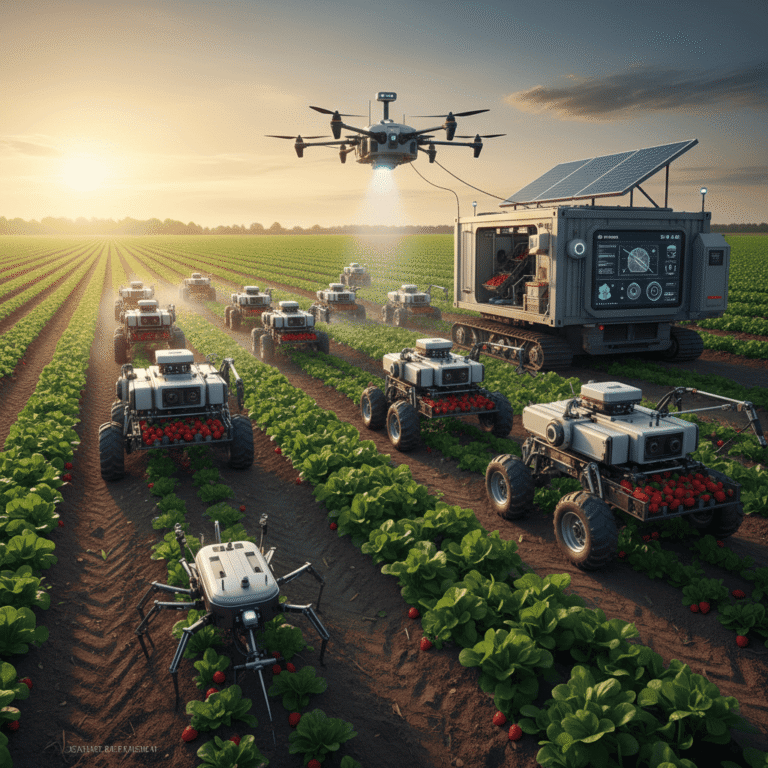
Agriculture faces unprecedented challenges in the 21st century. A growing global population expected to reach nearly 10 billion by 2050, combined with labor shortages, climate change, water scarcity, and the need for sustainable practices, is pushing the industry toward a technological revolution. At the forefront of this transformation are agricultural robots — also known as agribots — which are rapidly moving from experimental prototypes to essential tools on modern farms.
The global agricultural robotics market was valued at approximately USD 11.24 billion in 2026 and is projected to reach between USD 28 billion and USD 57 billion by 2030–2034, growing at a compound annual growth rate (CAGR) of 15–25% depending on the source. This explosive growth reflects both necessity and opportunity.
Why Agriculture Needs Robots
Traditional farming is labor-intensive, physically demanding, and increasingly short on workers. In many developed countries, rural populations are aging, and younger generations are reluctant to take on back-breaking seasonal work. Robots address this gap by performing repetitive, dangerous, or precision tasks 24/7 with consistent quality. They also enable precision agriculture — applying water, fertilizer, and pesticides only where needed — which reduces costs and environmental impact.
Key Applications of Robots in Agriculture
1. Weeding and Precision Spraying One of the most commercially successful applications today is autonomous weeding. Companies like Carbon Robotics, Ecorobotix, and Naïo Technologies deploy robots that use AI-powered computer vision and LiDAR to distinguish crops from weeds. Some use mechanical blades or lasers to destroy weeds without chemicals, addressing herbicide resistance and reducing chemical usage by up to 90%. Solar-powered robots like FarmDroid FD20 can seed and mechanically weed fields with remarkable precision (down to 8mm accuracy).
2. Harvesting Robots Harvesting delicate fruits and vegetables remains one of the hardest tasks to automate, but progress is accelerating.
- Fieldwork Robotics (UK) has developed autonomous raspberry harvesters.
- Ripe Robotics (Australia) works on stone fruits and apples.
- 4AG Robotics (Canada) offers fully autonomous mushroom harvesting systems.
- Tevel Aerobotics uses flying robots with soft grippers for fruit picking.
These systems use advanced 3D vision, soft robotics, and machine learning to handle produce gently, reducing bruising and waste.
3. Autonomous Tractors and Field Vehicles Major manufacturers like John Deere, CNH Industrial, and Kubota are commercializing autonomous tractors. Smaller, lighter robots from companies like SwarmFarm Robotics operate in fleets, performing tasks such as mowing, planting, and spraying while coordinating with each other.
4. Drones and Aerial Robotics Agricultural drones equipped with multispectral cameras, AI analytics, and spraying systems are now mainstream. They provide rapid crop monitoring, detect diseases or nutrient deficiencies early, and enable spot-spraying. In 2026, hybrid systems combining ground robots with drone oversight are becoming common.
5. Livestock Management Robots are transforming animal agriculture too. Automatic milking systems have been around for years, but newer robots handle feeding, cleaning barns, and even herding cattle (such as Australia’s Swagbot).
6. Soil Analysis, Planting, and Monitoring Ground robots equipped with sensors can map soil health, plant seeds with extreme precision, and continuously monitor crop growth. This data feeds into farm management platforms for predictive insights.
Benefits and Broader Impact
Robotics in agriculture delivers multiple advantages:
- Labor Efficiency: Robots reduce dependency on seasonal workers.
- Sustainability: Precision application cuts chemical and water usage dramatically.
- Yield Improvement: Early detection of problems and optimized care lead to healthier crops.
- 24/7 Operation: Solar-powered systems can work around the clock.
- Data-Driven Decisions: Robots generate massive amounts of actionable field data.
Challenges to Widespread Adoption
Despite strong momentum, barriers remain. High upfront costs make robots inaccessible to many small and medium farms. Technical challenges persist in complex environments (uneven terrain, mud, varying weather). Integration with existing equipment and reliable connectivity in rural areas are ongoing issues. Regulatory frameworks for fully autonomous machines are still evolving.
However, innovative business models such as Robotics-as-a-Service (RaaS) — where farmers pay per acre or per task rather than buying expensive machines — are making the technology more accessible.
The Road Ahead
By 2030, experts expect fleets of collaborative robots working alongside humans in “human-in-the-loop” systems. Advances in embodied AI, better batteries, improved grippers, and swarm intelligence will expand capabilities further. Vertical farming and controlled-environment agriculture are also seeing heavy robotic integration.
Agriculture, one of humanity’s oldest industries, is undergoing its most profound modernization yet. Robots are not replacing farmers — they are empowering them to feed a growing world more efficiently, sustainably, and profitably than ever before.
The farms of the future will still be managed by skilled humans, but they will be powered by intelligent machines working tirelessly in the fields. The agricultural robot revolution is no longer coming — it is already here.

Author: RobotsInc.com
The RobotsInc Editorial Team is dedicated to covering the global robotics industry with accuracy, clarity, and technical insight. Our editors research emerging technologies, industry trends, product launches, and business developments to deliver informative, fact-based articles for engineers, manufacturers, researchers, investors, and robotics enthusiasts.