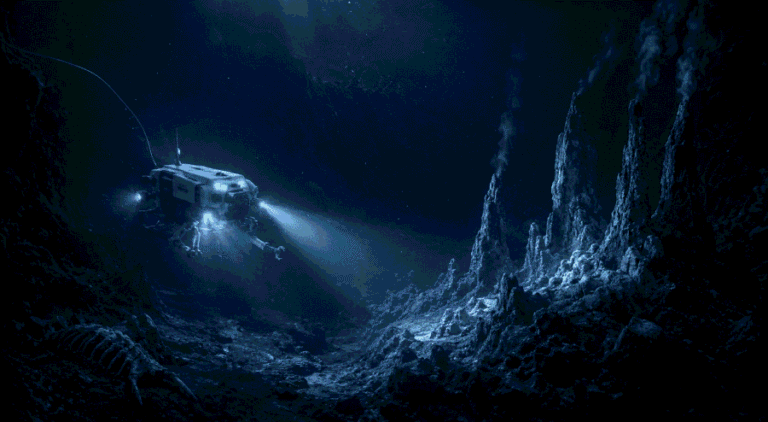
The ocean covers more than 70% of Earth’s surface, yet humanity has explored less than 5% of its depths in detail. The deepest points, such as the Challenger Deep in the Mariana Trench at nearly 11,000 meters (about 36,000 feet), remain among the most inaccessible and hostile environments on the planet. Crushing pressures exceed 1,000 times atmospheric pressure at the surface, temperatures hover near freezing, and complete darkness prevails. For decades, manned submersibles like the iconic Alvin pushed boundaries but faced severe limitations in cost, risk, and endurance. Today, robots—primarily Remotely Operated Vehicles (ROVs) and Autonomous Underwater Vehicles (AUVs)—have revolutionized unmanned underwater exploration, venturing where humans cannot and unlocking secrets of the deep sea.
These robotic systems act as our eyes, hands, and sensors in the abyss. They map uncharted seafloors, collect samples, photograph bizarre life forms, and monitor environmental changes, all while keeping human operators safely aboard surface vessels or onshore. As climate change, resource demands, and scientific curiosity intensify, robots are not just tools but essential pioneers, enabling sustained, large-scale investigation of the ocean’s final frontiers.
The Perils of Human Deep-Sea Exploration
Human presence in the deep ocean has always been fraught with danger. Early bathyscaphes and modern manned submersibles require thick pressure hulls, life support systems, and extensive support infrastructure, making dives expensive—often millions per mission—and limited in duration. Divers using scuba or atmospheric suits are restricted to a few hundred meters at most. Even advanced manned vehicles like China’s Fendouzhe or the U.S. Limiting Factor face risks from mechanical failure, entanglement, or the immense physical and psychological strain on crews.
The deep sea’s extreme conditions amplify these challenges. At hadal depths (below 6,000 meters), equipment must withstand implosive forces that can crush steel. Visibility is near zero without artificial light, currents are unpredictable, and communication with the surface is delayed or limited. These factors historically confined exploration to brief snapshots. Robots change this equation by removing humans from the risk zone, allowing bolder, longer, and more frequent missions.
From Early ROVs to Advanced AUVs
Underwater robotics traces its roots to the mid-20th century, initially for military and offshore oil applications. The transition to scientific exploration accelerated in the 1980s and 1990s. Japan’s Kaikō ROV reached the Challenger Deep in 1995, marking a milestone in robotic deep diving at around 10,911 meters. In 2009, the Woods Hole Oceanographic Institution’s hybrid vehicle Nereus plunged to 10,902 meters in the Mariana Trench, demonstrating the potential of untethered or lightly tethered systems for extreme depths.
ROVs remain tethered to a surface ship via a cable that supplies power and enables real-time control and high-bandwidth data transmission, including live HD video. This makes them ideal for detailed inspection, manipulation with robotic arms, and targeted sampling. Modern deep-sea ROVs like NOAA’s Deep Discoverer can operate to 6,000 meters or more, equipped with sophisticated cameras, lights, sonars, and sampling tools.
AUVs, by contrast, operate independently on pre-programmed missions. Untethered and battery-powered, they excel at broad-area surveys, mapping, and data collection over extended periods. Using inertial navigation, Doppler velocity logs, and acoustic positioning, they navigate autonomously, surfacing periodically to transmit data via satellite. Their compact size allows deployment from smaller vessels, reducing costs. Vehicles like Schmidt Ocean Institute’s platforms or Ocean Infinity’s fleets demonstrate how multiple AUVs can work in tandem for efficient seafloor mapping.
Recent innovations push boundaries further. Bio-inspired soft robots, modeled after resilient deep-sea creatures like snailfish, use flexible materials to withstand crushing pressures without rigid hulls. In 2021, a soft robot reached the Mariana Trench, highlighting potential for lighter, more adaptable designs. Tiny morphable robots developed by Chinese researchers have dived to over 10,600 meters, offering agile exploration in tight spaces.
Capabilities and Real-World Impact
Modern underwater robots integrate advanced sensors: multibeam sonar for high-resolution bathymetry, LED lighting and cameras for imaging, environmental DNA (eDNA) samplers, and chemical sensors for detecting hydrothermal vents or pollutants. They can land on the seafloor, collect sediment or biological samples, and even perform photomosaics to create detailed visual maps.
In exploration, robots have transformed our understanding. AUVs map vast swaths of the seafloor, revealing underwater mountains, canyons, and ecosystems. ROVs document hydrothermal vents teeming with chemosynthetic life—organisms that thrive without sunlight—expanding knowledge of life’s origins and resilience. Discoveries include new species, geological features, and even human artifacts like shipwrecks.
Robots also support practical applications. They inspect subsea infrastructure for the energy sector, monitor coral reefs and biodiversity for conservation, and aid in search-and-recovery operations. In scientific expeditions, one ship can deploy multiple AUVs, multiplying coverage while researchers analyze data in real time or asynchronously. This efficiency is crucial for studying climate impacts, such as ocean acidification or carbon sequestration in the deep sea.
Safety and cost advantages are profound. Unmanned systems eliminate risks to human life and enable operations in hazardous conditions, such as under ice or near volcanic activity. While initial development is expensive, operational savings are significant compared to manned dives. AUVs, in particular, allow “set it and forget it” missions, freeing crews for other tasks.
Challenges and Limitations
Despite progress, hurdles remain. Battery life limits AUV endurance, though improvements in energy density help. Communication underwater is slow and low-bandwidth; ROV tethers face depth-related engineering challenges. Extreme pressure demands robust materials, and biofouling or corrosion can impair long missions. Data volumes are enormous, requiring AI for processing and interpretation.
Environmental concerns also arise: robots must minimize disturbance to fragile deep-sea ecosystems. Regulatory frameworks for deep-sea mining or exploration lag behind technological capability.
The Future: Swarms, AI, and Beyond
The horizon for underwater robotics is exciting. AI and machine learning will enable greater autonomy, allowing vehicles to adapt to unexpected conditions, identify scientifically valuable targets in real time, or cooperate in swarms for comprehensive surveys. Resident AUVs could remain deployed for months, docking at underwater stations for recharging and data offload. Hybrid systems combining ROV precision with AUV range are emerging.
Integration with other technologies—satellites, autonomous surface vessels, and even space-inspired navigation—will expand reach. Soft robotics and miniature designs promise access to crevices and extreme environments previously unreachable. As costs decrease, more nations and institutions can participate, democratizing deep-sea science.
In the coming decades, robots may fully chart the ocean floor, monitor global changes, and support sustainable blue economies. They could even search for extraterrestrial analogs, as deep-sea vents resemble potential habitats on icy moons.
Conclusion
Robots have become indispensable ambassadors to the ocean’s deepest realms, venturing into crushing darkness where humans dare not tread unaided. From the pioneering dives of Kaikō and Nereus to today’s soft-bodied innovators and autonomous fleets, these machines are rewriting the story of marine exploration. They enhance safety, expand knowledge, and inspire wonder about our planet’s last great wilderness. As technology advances, the partnership between humans and robots will continue to illuminate the abyss, revealing not only the ocean’s mysteries but also insights critical for Earth’s future. The depths that once seemed forever beyond reach are now within our robotic grasp—opening an era of discovery limited only by imagination.

Author: RobotsInc.com
The RobotsInc Editorial Team is dedicated to covering the global robotics industry with accuracy, clarity, and technical insight. Our editors research emerging technologies, industry trends, product launches, and business developments to deliver informative, fact-based articles for engineers, manufacturers, researchers, investors, and robotics enthusiasts.