Profile
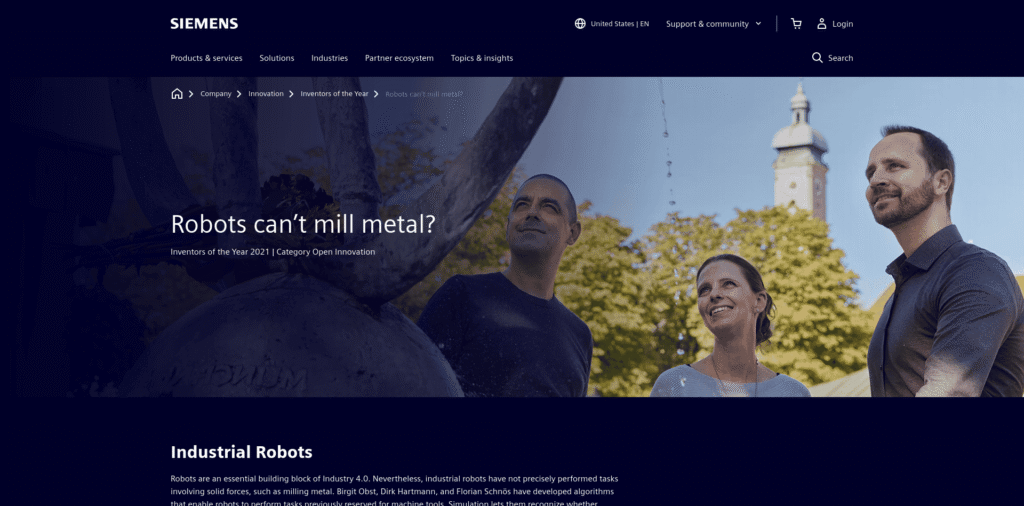
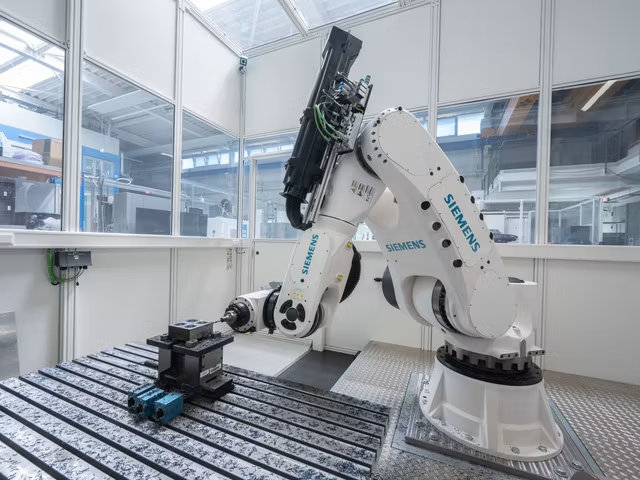
Siemens is a global technology powerhouse with a storied history dating back to its founding in 1847 by Werner von Siemens. Headquartered in Munich, Germany, Siemens operates in over 200 countries with roughly 320,000 employees and generates annual revenue exceeding €80 billion. The company specializes in electrification, automation, digitalization, and sustainable infrastructure. Its Industrial Automation and Digital Industries divisions are particularly prominent in transforming traditional manufacturing into smart factories under the Industry 4.0 paradigm. The webpage at siemens.com/en-us/company/innovation/inventors/industrial-robots highlights Siemens’ long legacy of innovation, profiling key inventors and patents that have shaped modern industrial robotics. While Siemens does not primarily manufacture robotic manipulator arms (leaving that to specialists like KUKA, ABB, and FANUC), it provides the critical “brains,” control systems, software, drives, and digital ecosystem that make industrial robots intelligent, efficient, and seamlessly integrated into production lines.
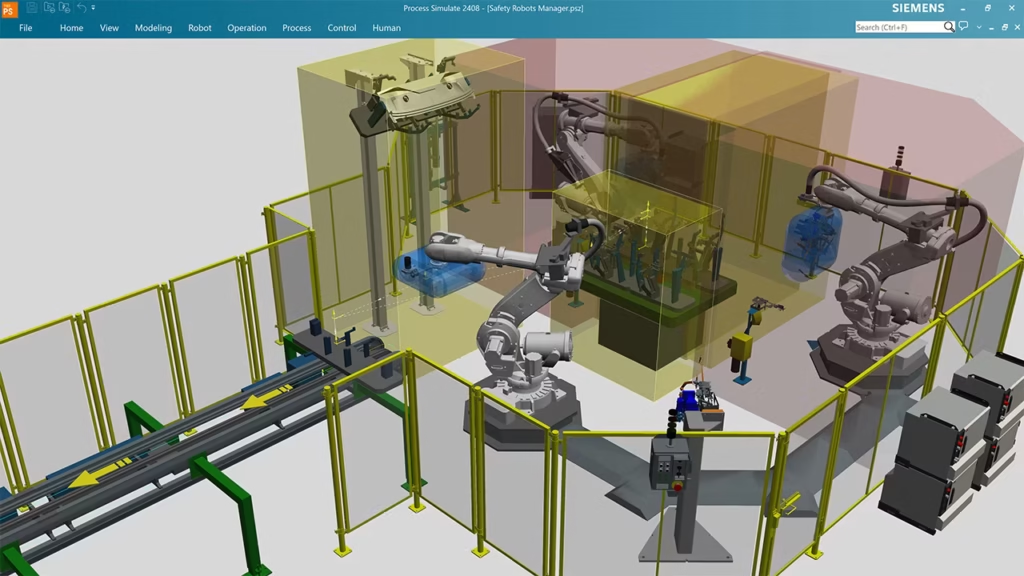
At the core of Siemens robot-based products is the Totally Integrated Automation (TIA) Portal, a single engineering environment that unifies robot programming with PLCs, drives, HMIs, and safety systems. The SIMATIC Robot Library delivers pre-configured function blocks and templates that drastically reduce integration time for robots from multiple vendors. Complementing this is SINUMERIK Run MyRobot technology and SINAMICS servo drives, which deliver high-precision motion control, complex kinematics, and dynamic path planning for applications ranging from welding and machining to assembly and material handling. Siemens’ strength in digital twin technology, delivered through the Siemens Xcelerator portfolio and software such as NX, Tecnomatix, and Process Simulate, enables virtual commissioning of entire robotic work cells. Manufacturers can simulate, optimize robot paths, detect collisions, analyze throughput, and debug offline, often cutting physical commissioning time and costs by 30-70%.
The innovation page emphasizes Siemens inventors’ contributions to foundational technologies including numerical control systems from the 1950s–60s, sensor fusion, force-torque sensing for delicate assembly tasks, collision avoidance, and AI-driven adaptive behaviors. Modern solutions leverage Industrial Edge computing for real-time analytics and low-latency decision making directly on the factory floor, while MindSphere (now part of Xcelerator) provides cloud-based fleet management, predictive maintenance, and performance benchmarking across distributed robotic assets. Safety-integrated features ensure compliance with ISO 10218 and ISO/TS 15066 standards, enabling true human-robot collaboration (cobots) without traditional guarding. Open standards such as PROFINET and OPC UA allow Siemens robots to function as interconnected nodes within cyber-physical systems rather than isolated machines.
Siemens robotics solutions serve diverse sectors including automotive flexible assembly, electronics precision handling, pharmaceutical sterile packaging, logistics with autonomous mobile robots (AMRs), and consumer goods. Sustainability is embedded in the offerings, with energy-optimized drive systems and AI algorithms that reduce carbon footprints. Looking forward, Siemens is advancing 5G-connected robotics, reinforcement learning for autonomous adaptation, and fully software-defined manufacturing. By combining hardware interoperability, sophisticated simulation, edge AI, and a unified digital thread, Siemens empowers manufacturers to achieve greater productivity, flexibility, customization, and resilience—positioning itself as an indispensable partner in the factory of the future.
Map
Sorry, no records were found. Please adjust your search criteria and try again.
Sorry, unable to load the Maps API.