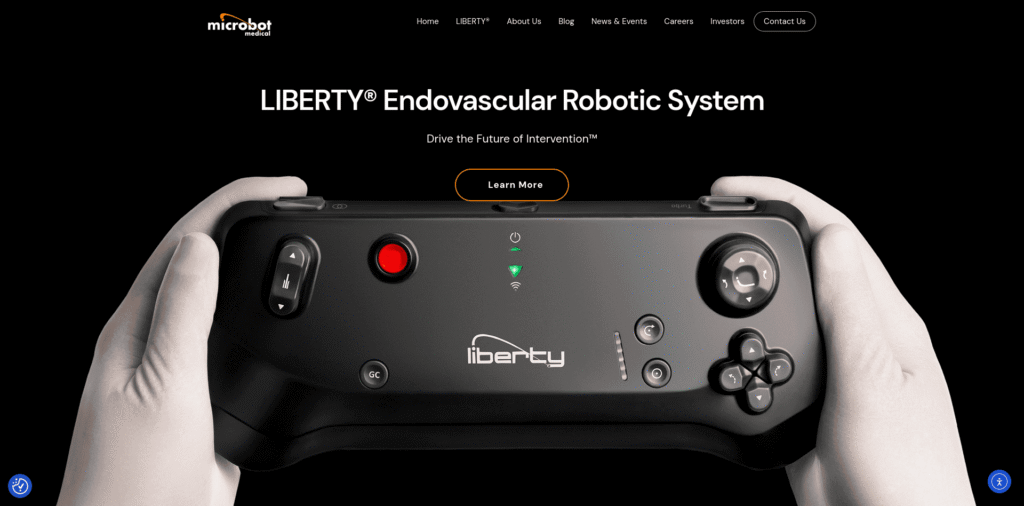
![Surgeon’s gloved hands operate a robotic-assisted surgical controller connected to a compact console under blue sterile drapes.]?](https://robotsinc.com/wp-content/uploads/2026/07/Liberty-Close-Up-web-min.jpg "» RobotsInc.com")
Profile
Microbot Medical develops advanced medical robotics focused on endovascular procedures. The company is a publicly traded (NASDAQ: MBOT) commercial-stage medical device firm headquartered in Hingham, Massachusetts. Founded in 2010 by Harel Gadot, Prof. Moshe Shoham, and Yossi Bornstein, it began operations in 2011 and listed on NASDAQ in 2016. Early efforts centered on micro-robotic platforms like ViRob, an autonomous crawling micro-robot designed for navigation in blood vessels and other body lumens, and TipCAT, a self-propelled flexible endoscope for tubular structures. Over time, the company refocused its pipeline on a single core technology to address specific needs in interventional medicine.
Its mission emphasizes delivering transformative interventional robotic solutions that prioritize patient care, empower providers, and improve access to advanced treatments anytime and anywhere. Harel Gadot has led the company as CEO, President, and Chairman since its founding, drawing on prior experience in global strategic marketing at Johnson & Johnson. The executive team and board include professionals with deep backgrounds at Boston Scientific, Haemonetics, Corindus Vascular Robotics, Olympus, and other leading medtech organizations, covering expertise in regulatory affairs, clinical strategy, sales, marketing, technology development, and operations.
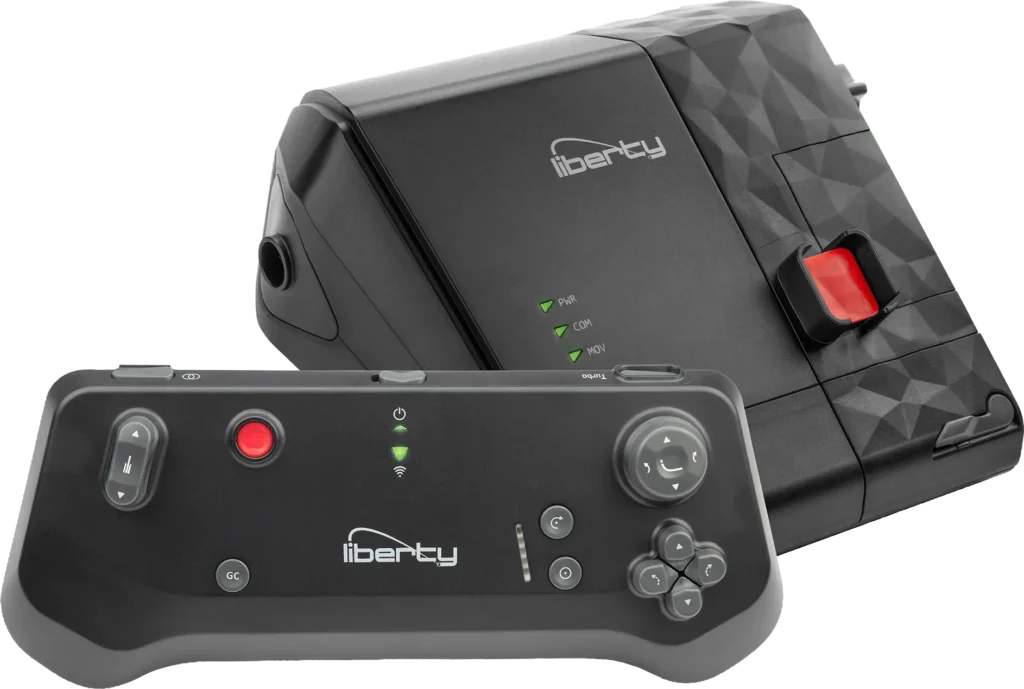
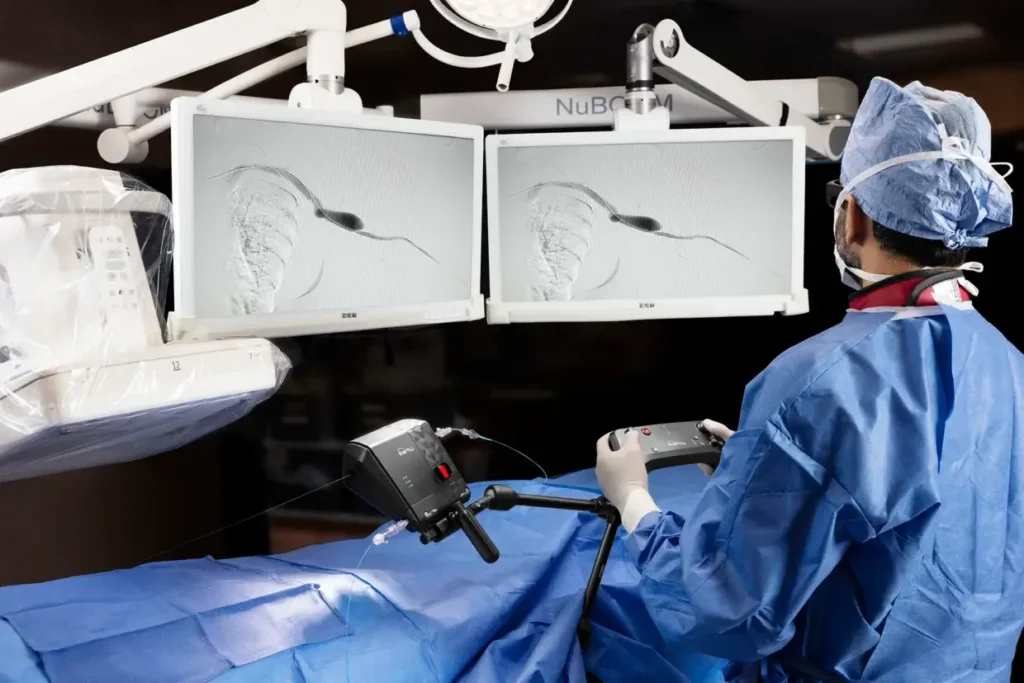
The flagship product is the LIBERTY® Endovascular Robotic System, described as the first single-use, remotely operated robotic solution cleared by the FDA for peripheral endovascular procedures. It enables precise remote delivery and manipulation of guidewires, catheters, and guide catheters in the peripheral vasculature (not intended for coronary or neurointerventional use). Physicians control the system from a seated position across the room, using a robotic drive, remote control unit, and mounting arm. The compact, single-use design requires no large capital equipment investment and integrates into existing cath lab workflows.
Key technical and operational features include simple setup in under five minutes, universal compatibility with a wide range of preferred guidewires and catheters, and AccuGrip™ technology to securely hold devices during procedures. The system provides smooth, responsive navigation while aiming to maintain high levels of control and precision.
LIBERTY was engineered to overcome longstanding challenges in interventional radiology and vascular procedures. Physicians performing traditional manual interventions face significantly elevated risks, including six times higher rates of cataracts and three times higher malignancy risk from cumulative radiation, as well as musculoskeletal injuries reported by roughly two-thirds of interventionalists due to heavy lead aprons and prolonged standing. Hospitals often encounter barriers such as high upfront costs, staffing shortages in interventional specialties, physician burnout, and geographic access limitations, with rural Americans facing disproportionate underserved status. The single-use model lowers financial and infrastructure hurdles while the remote seated operation improves ergonomics and supports safer participation for physicians planning families.
Clinical evidence supporting LIBERTY comes from the ACCESS-PVI trial, which reported 100% successful robotic navigation in all cases, no adverse device effects, and a 92% relative reduction in operator radiation exposure. Independent physician feedback from sites including Yale Medical Center, Timone Hospital, Institut Gustave Roussy, and Miami Cardiac & Vascular Institute highlights ease of setup, target access, and the system’s potential to break down barriers to robotic adoption without the complexity or cost of traditional capital-heavy platforms.
The company has moved into active commercialization. It initiated limited market release of the LIBERTY system in late 2025 and advanced toward full market release in 2026, securing early U.S. healthcare system customers, including its first account in North Carolina. A LIBERTY Starter Kit provides training, support, and discounted volumes to help hospitals launch programs with lower risk. The company maintains a strong intellectual property portfolio and positions LIBERTY as the foundation for a new category of accessible, single-use endovascular robotics rather than reusable capital equipment systems.
Microbot differentiates its approach by emphasizing physician comfort, reduced radiation, workflow simplicity, and broader patient access over complex infrastructure requirements common in earlier robotic systems. With ongoing market expansion efforts, the company continues to highlight how its technology can help interventional teams address radiation safety, ergonomics, staffing constraints, and equity in care delivery.
Map
Sorry, no records were found. Please adjust your search criteria and try again.
Sorry, unable to load the Maps API.