Profile
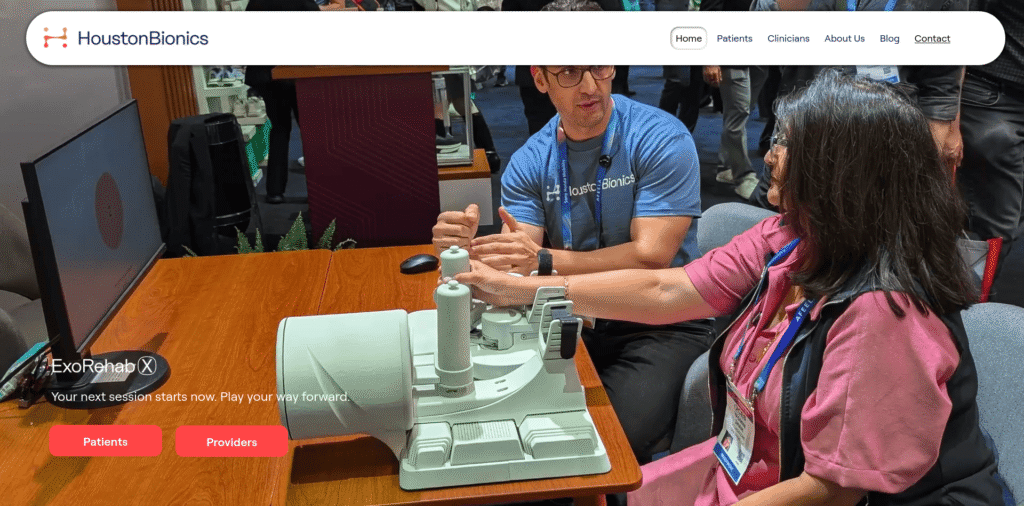
HoustonBionics is a medical robotics company focused on upper-extremity rehabilitation for people recovering from stroke and traumatic brain injury. Its flagship product, ExoRehab X, is designed to help users practice arm and hand movements at home with high repetition, goal-directed training that complements clinical care rather than replacing it. The company’s website and supporting materials frame the product as a way to close one of the biggest gaps in neurorehabilitation: the drop in therapy intensity that often happens after a patient leaves the clinic. By bringing structured practice into the home, HoustonBionics aims to make recovery more continuous, measurable, and accessible.
The company’s core idea is rooted in the science of neuroplasticity, the brain’s ability to adapt through repeated, task-specific practice. HoustonBionics says its rehabilitation approach is built around movements that are voluntarily initiated by the user, goal-directed, and challenging enough to drive meaningful improvement. In practical terms, this means the device is not a passive assistive tool. Instead, it is intended to encourage active participation, which is important in regaining motor function after neurological injury. The system provides assistance only as needed, so users can complete movements while still doing the work themselves.
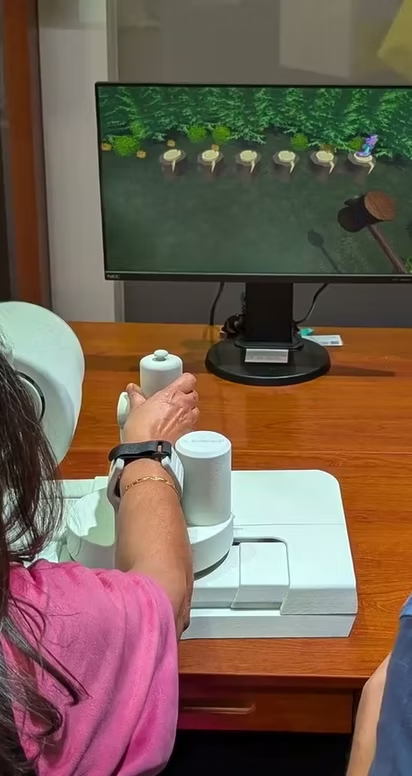
ExoRehab X is described as an at-home upper-extremity rehabilitation platform, and the available information suggests it uses wearable robotics or an exoskeleton-style interface to support arm and forearm therapy. The product is aimed at recovering distal upper-extremity function, including the movements needed for daily activities. HoustonBionics emphasizes high-intensity, high-repetition training, which is often difficult to maintain in standard outpatient settings because of time, staffing, and access limitations. By turning the home into a “smart recovery clinic,” the company is trying to extend therapy beyond traditional appointments and into everyday routines.
A major strength of the product is its focus on engagement and feedback. Materials describing ExoRehab X mention gamified training, visual feedback, and progress tracking. Those features matter because rehabilitation devices often fail when patients lose motivation or cannot clearly see improvement. By giving users objective data and interactive feedback, HoustonBionics appears to be making therapy more understandable and easier to sustain. This is especially important for stroke survivors, who may need months of consistent practice to regain function.
HoustonBionics also positions its technology as a complement to clinicians and caregivers. Rather than replacing therapy professionals, the system is intended to help users continue therapy independently between visits or after discharge. That makes it relevant not only for individual patients but also for rehab providers who want to improve compliance and extend the effects of therapy programs. The company’s materials and public interviews suggest that the broader goal is to reduce the treatment gap that many patients face once formal care ends.
Overall, HoustonBionics is building rehabilitation robotics with a very specific purpose: helping people recover upper-extremity function after neurological injury through structured, at-home, high-repetition training. Its product strategy combines robotics, neurorehabilitation principles, and digital feedback in a way that is meant to improve continuity of care and support long-term recovery outcomes.


Map
Sorry, no records were found. Please adjust your search criteria and try again.
Sorry, unable to load the Maps API.