
Profile
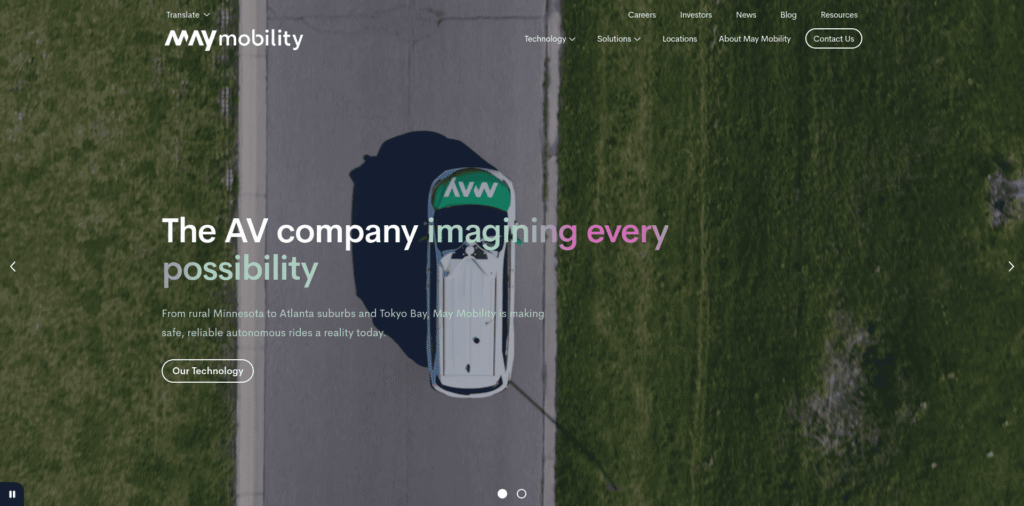
May Mobility is an Ann Arbor, Michigan-based autonomous vehicle company developing and deploying driverless technology for ride-hail, microtransit, and commercial transportation. Founded to make safe, reliable autonomous mobility available at scale, the company operates today in both the United States and Japan with deployments ranging from urban ride-hail services to community microtransit and commercial fleets.
Its core technology is the proprietary Multi-Policy Decision Making (MPDM) system, which combines a real-time world model with a multi-policy reasoning engine. Unlike traditional AV systems that rely heavily on pre-collected training data, MPDM enables vehicles to understand the current scene and simulate hundreds of possible future scenarios every 200 milliseconds. The system then scores multiple candidate driving strategies and selects the safest action while rejecting unsafe ones. This approach allows the vehicles to generalize to new environments and handle unexpected situations more effectively than rules-based or purely end-to-end models.
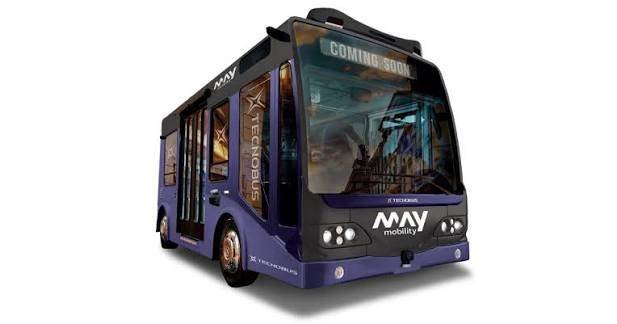
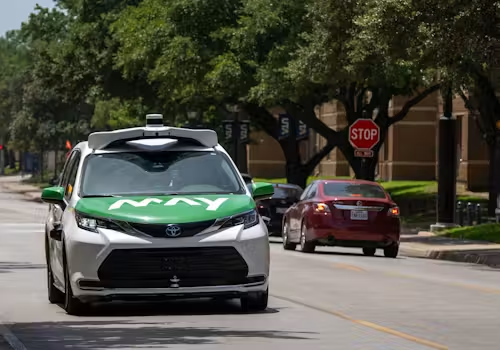
The company’s robot-based products consist of autonomous passenger vehicles and minibuses equipped with its MPDM autonomy stack. These vehicles support fully driverless commercial ride-hail operations (including recent launches with Lyft in Atlanta and partnerships with Uber for robotaxi deployment) as well as first- and last-mile microtransit services for cities, campuses, airports, healthcare facilities, and planned communities. May Mobility has also introduced all-electric robo-buses featuring swappable batteries and higher passenger capacity. The technology has been deployed across diverse conditions, from snowy roads in Michigan to urban environments in Tokyo, and the company reports more than 10 community deployments to date.
May Mobility emphasizes safety through on-board real-time simulation and traceable decision-making. It partners with major organizations including Lyft, Uber, Grab, NTT, Toyota, and ECARX to scale operations and expand into Southeast Asia. The company positions its architecture as more scalable and cost-efficient than competitors because it requires less exhaustive pre-training data and expensive compute.
Map
Sorry, no records were found. Please adjust your search criteria and try again.
Sorry, unable to load the Maps API.