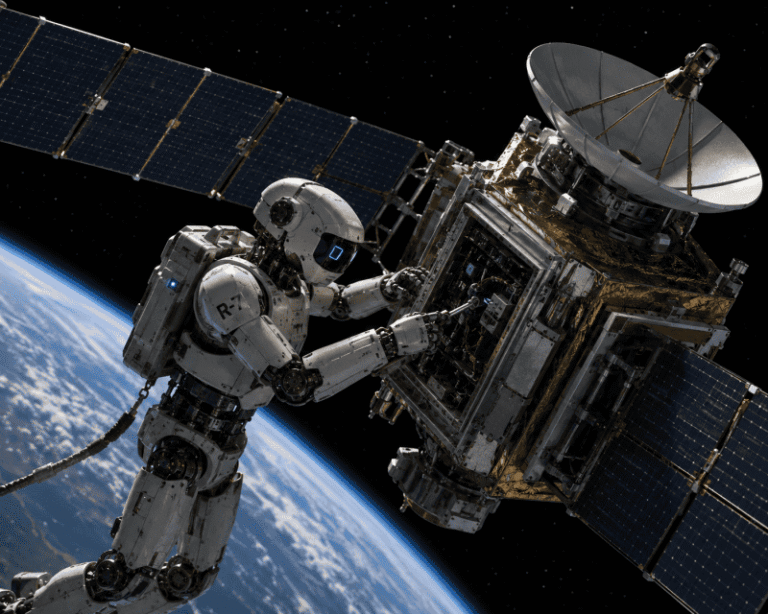
The final frontier has always been hostile to human life. Radiation, extreme temperatures, vacuum, microgravity, and vast communication delays make direct human exploration risky and expensive. Robots, however, thrive where humans cannot. From the early Luna and Mariner probes of the 1960s to today’s Perseverance rover and Ingenuity helicopter on Mars, robotic systems have been humanity’s primary emissaries in space. As we prepare for sustained lunar presence under Artemis, crewed Mars missions, and commercial asteroid mining, robots are evolving from remote-controlled tools into autonomous partners. Their design features, levels of autonomy, operational methods, and communication architectures will determine how effectively they pioneer, build, and support human expansion into the solar system.
Design Features: Built for the Void
Space robots require specialized features to survive environments that would destroy consumer electronics in seconds. Radiation is a primary threat. Cosmic rays and solar particle events can flip bits in computer memory or degrade solar panels. Engineers respond with radiation-hardened (“rad-hard”) electronics, often several generations behind commercial chips but far more reliable, supplemented by shielding, error-correcting code, and redundant systems that allow graceful degradation.
Thermal control is equally critical. In space, temperatures swing violently. A spacecraft in sunlight can reach 120°C while its shadow side plunges to -150°C or lower. Multi-layer insulation (MLI), heat pipes, louvers, electric heaters, and active cooling loops maintain operational ranges. On Mars, dust accumulation on solar panels—famously ending the Opportunity rover’s mission—has driven the adoption of nuclear power in the form of Multi-Mission Radioisotope Thermoelectric Generators (MMRTGs). These plutonium-powered units provide steady electricity and waste heat for years, enabling Perseverance to operate through dust storms and long Martian nights. Future missions may incorporate small fission reactors for even greater power budgets.
Mobility systems are tailored to the target environment. Wheeled rovers use sophisticated rocker-bogie suspensions to handle rocks, sand, and slopes. Perseverance can autonomously navigate terrain that would challenge a human driver. For airless bodies with low gravity, legged robots or hopping mechanisms offer advantages; JAXA’s MASCOT lander demonstrated this on asteroid Ryugu. In atmospheres, rotorcraft like Ingenuity have proven powered flight is possible on Mars, while NASA’s Dragonfly mission will send a nuclear-powered quadcopter to explore Titan’s thick atmosphere and hydrocarbon lakes in the 2030s.
Manipulators remain central. Multi-degree-of-freedom robotic arms equipped with cameras, drills, grinders, and scientific instruments allow precise sampling. Perseverance’s arm has already collected dozens of cached samples for eventual Earth return. Sensors include high-resolution stereo cameras, LIDAR for 3D mapping, spectrometers (visible, infrared, X-ray), ground-penetrating radar, and meteorological suites. These generate terabytes of data that must be processed, prioritized, and transmitted.
Lightweight but strong materials—carbon composites, titanium, and advanced alloys—reduce launch mass while maintaining structural integrity. Fault tolerance is engineered at every level; many systems include multiple identical computers that vote on decisions, discarding faulty units automatically.
Autonomy: From Remote Control to Independent Thinkers
The greatest limitation on robotic operation in deep space is the speed of light. Commands to Mars take 4 to 24 minutes one way. Round-trip communication with Jupiter’s moons can exceed an hour. Waiting for ground approval before every action is impossible. This reality has driven increasing autonomy.
Current systems operate on multiple tiers. Basic “command sequencing” involves uploading timed lists of instructions that the robot executes without further input. Supervised autonomy allows ground controllers to set high-level goals (“drive toward that crater and sample any interesting rocks”), while the robot handles details. Perseverance’s AutoNav system uses computer vision and terrain analysis to plan safe paths, avoid hazards, and cover more ground per sol than earlier rovers. Its AEGIS instrument autonomously selects high-value targets for its laser spectrometer.
True intelligence is emerging through artificial intelligence and machine learning. Modern rovers employ neural networks for image classification—distinguishing scientifically valuable rocks from ordinary ones—and reinforcement learning for improved navigation over time. The Mars 2020 mission demonstrated onboard prioritization of images and summaries to reduce data transmission needs.
Future robots will push toward even higher autonomy. Researchers are exploring onboard large language models (adapted for space constraints) and advanced planning algorithms that allow robots to replan missions when unexpected opportunities or failures arise. Self-diagnosis and self-repair capabilities, already partially demonstrated on the Hubble Space Telescope servicing missions, will become standard. Swarm robotics concepts envision dozens or hundreds of small probes coordinating without constant human input, using collective intelligence to map subsurface oceans on Europa or explore cave systems on the Moon.
For crewed missions, robots will act as true collaborators. Humanoid designs like NASA’s Valkyrie or ESA’s Rollin’ Justin can work alongside astronauts, while smaller free-flying assistants (like the Astrobee robots on the ISS) handle routine tasks. The goal is “shared autonomy,” where humans provide high-level intent and robots fill in the thousands of low-level control actions required in microgravity or awkward spacesuits.
How Robots Will Work: Tasks and Operational Paradigms
Robots will perform four broad categories of work: exploration and science, infrastructure construction, maintenance and assembly, and resource utilization.
Exploration robots map, characterize, and sample. They precede humans, identifying hazards and resources. The VIPER rover, scheduled for the Moon, will search for water ice in permanently shadowed craters. Sample-return missions like OSIRIS-REx (which successfully collected material from asteroid Bennu) demonstrate the dexterity required for delicate extractions.
In construction, robots will use additive manufacturing—3D printing with regolith or imported materials—to build landing pads, habitats, and radiation shields before humans arrive. Concepts from ICON and NASA show autonomous bricklaying or sintering robots that operate continuously under solar power or with nuclear backup.
Maintenance robots will service satellites, refuel spacecraft in orbit, and conduct repairs on the Lunar Gateway or Martian habitats. The ISS already depends heavily on the Canadian robotic arm (Canadarm2) and Dextre for external work. Future orbital “robot garages” may house fleets of small repair satellites.
In-situ resource utilization (ISRU) is perhaps most transformative. Robots will mine lunar ice for oxygen and hydrogen propellant, process Martian atmosphere into methane fuel (as tested by MOXIE on Perseverance), and eventually support asteroid mining operations extracting platinum-group metals or water.
Power, navigation, and thermal systems described earlier enable continuous operation. In microgravity, robots use reaction wheels, cold-gas thrusters, or controlled tethers. On planetary surfaces, they contend with dust that adheres electrostatically to everything; special coatings and electrostatic cleaners are under development. Operation cycles often follow a “command-execute-downlink” rhythm, with long periods of autonomous activity punctuated by high-bandwidth data returns when relay orbiters are overhead.
Communication: Bridging Billions of Kilometers
Reliable communication is the nervous system connecting robots to Earth and to each other. The Deep Space Network (DSN)—a global array of 34- and 70-meter radio dishes—remains the backbone. Robots use high-gain antennas for focused beams and low-gain antennas for emergencies. X-band and Ka-band frequencies balance data rate and reliability.
Data rates remain modest by terrestrial standards. A Mars rover might achieve 2–4 megabits per second during optimal relay windows via orbiters like Mars Reconnaissance Orbiter. That is why compression, prioritization, and onboard summarization are essential.
Optical laser communication promises orders-of-magnitude improvement. NASA’s Psyche mission has already demonstrated laser links across 225 million kilometers at rates far exceeding traditional radio. Future lunar and Martian networks will combine surface relays, orbital constellations, and laser terminals to create an interplanetary internet.
The Delay-Tolerant Networking (DTN) protocol, already tested on the ISS and in deep space, treats communication as fundamentally intermittent. Bundles of data are stored and forwarded opportunistically, much like the old internet’s predecessor networks.
Between robots, mesh networking allows swarms or teams to share data locally without routing everything through Earth. A scout drone could relay findings to a nearby rover, which aggregates information before beaming a concise report home. For human-robot teams, natural language interfaces, gesture recognition, and augmented reality overlays will make interaction intuitive.
Future Prospects and Challenges
By the 2030s and 2040s, we can expect robot crews preparing Mars habitats, swarms of tiny probes diving into Europa’s ocean, and autonomous factories processing lunar resources. Ethical and technical questions remain: how much autonomy should we grant machines capable of independent decisions? How do we ensure AI systems remain aligned with human values across multi-year missions with limited oversight?
Challenges include ever-present radiation, psychological “isolation” for AI systems that must learn without constant updates, and the need for vastly improved energy density. Yet progress in AI, materials science, and miniaturization is rapid.
Robots will not replace humans in space; they will enable them. They endure the years-long journeys, the lethal radiation, and the crushing boredom of long autonomous traverses. In doing so, they become our eyes, hands, and minds across the solar system—pushing the frontier outward until humans can safely follow.

Author: RobotsInc.com
The RobotsInc Editorial Team is dedicated to covering the global robotics industry with accuracy, clarity, and technical insight. Our editors research emerging technologies, industry trends, product launches, and business developments to deliver informative, fact-based articles for engineers, manufacturers, researchers, investors, and robotics enthusiasts.